welcome-to-the-NHK-anime-about-Hikikomori
All Blog Posts, News in Japan

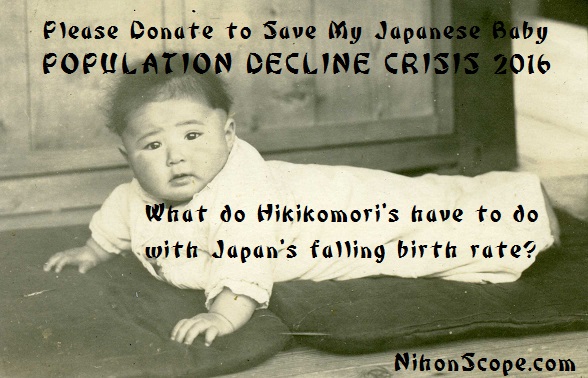
What Do Hikikomori’s Have to do With Birth Decline in Japan?

Why is Japan's Birth rate declining?Japan: Population Crisis 2016

Recluses and Overworked Husbands…

So what is all this talk about Japan and their population declining? Some say that they have enough people crammed over there already so whats the big deal? Well lets go through this and really analyze the situation so we can both better understand the decrease in birth rate in Japan.

Better Ways to Learn Japanese Fluently

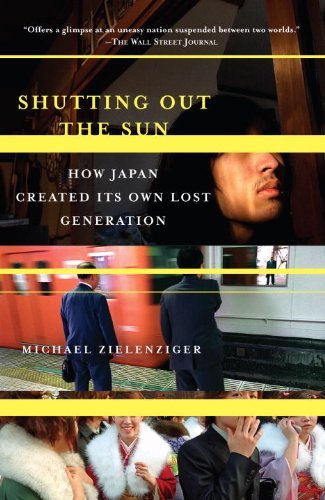
Hikikomori in Japan Book
I recommend Shutting out the Sun for those wishing to learn more about the social implications of Hikikomori in Japan.

Right now the Japanese population has one of the lowest birth rates in the entire world. But at the very same time we see that they have the longest living populace. So Japan is leaning more towards the elderly. So if you are looking to learn Japanese, it’s best to start speaking the elderly language (which you can begin learning here).

But to continue on, just a few years ago Japan peaked 128 million people living in the bounds of Japan. The population is set to decline by around 1,000,000 people every single year from now on. It’s said that by the year 2060 it’s estimated that there will only around 80-85 million people living inside Japan. More then half will be 60-65 years of age.

At this pace Japan will not have enough people to take care and support all of the elderly that have retired. This will create huge problem in the long run. But maybe Japan’s robot city will come to the rescue?

But Why is the Japanese Birth Rate So Low?

Well if you checked out my post about how to properly say the word sake (Sah-Kay) you’ll also remember an anime called ‘Welcome to the NHK’ where a hikikomori name Sato locks himself in his apartment, playing games, watching porn and basically just not mingling with the outside world. This syndrome is a real condition in Japan. Most of these hikikomori’s end up shutting themselves in their apartments or at their parents house with absolutely NO human contact beyond those who take care of them.

In fact there are a few government out reach programs whose sole job is to help them come back into society. There is even a program where female outreach therapists known commonly as ‘rental sisters’ come to push the hikikomori out into the world again. Many times these hikikomori’s will become recluse’s because of a rejection by a woman or by general embarrassment in society.

But this can’t be the only reason why the society as a whole is dropping the birth-rate ball? Well, it’s a huge part but it’s also because many people in Japan are no longer getting married, and it comes down to a woman being tied down strictly to raising kids while their husband works 50 hours a week, hoping that karoshi (death from over work) doesn’t sneak in and steal away their husband in the dead of night.

A Japanese husband on average will help with the children and housework 1 hour a day, compare that with western men who help 3 hours a day. It’s a huge difference, and because of this many woman are not looking forward to getting with anyone and starting a family. The Japanese government is looking to push further incentives for house wives to have children and be able to work to pay for their family by offering more government assisted programs for day-care so they no longer have to choose between being able to survive, have children and a husband and not jump in front of a train.

So there you have it, over worked husbands, higher costs of living and hikikomori’s…

As you can already see I attached the first episode of “Welcome to the NHK” above. I’ll be adding this series in the Anime and Manga section soon!

Read More
Kongo Gumi Construction Company in Japan 800 years old
All Blog Posts, History in Japan

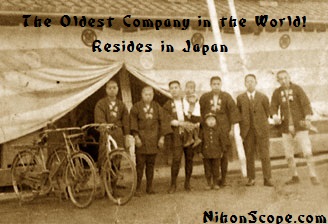
The Oldest Company in the World Resides in Japan

The Oldest Construction Company in the WorldKongo Gumi – The Oldest Company in Japan is a Construction Business!

Kongo Gumi Co., Ltd. is the world’s oldest continuously running independent company ever to exist, Kongo Gumi can be traced back to 578 AD when it first started. Until 2006 when it was absorbed as a subsidiary. Can you imagine being apart of a company that’s existence has been around 1,400 years?

Better Ways to Learn Japanese Fluently

(PRESS THE CC BUTTON IN THE VIDEO FOR SUBTITLES) A huge three meter (seventeenth century) scroll draws a line back 40 generations to where this humble Japanese construction company began. The company was passed down through sons and a daughters since son-in-laws would be taken into the family name.

Sadly in 2006 they liquidated their assets to a company called Takamatsu Construction Group. Before things fell apart this company had over 100 dedicated employees and a 7.5 billion Yen annual business. ($70 Million USD). Kongo Gumi was a specialist in constructing Buddhist temples. The very last president of this noble construction company was Madakazu Kongo, which was the 50th president of this family to run the company.

Although they are not fully independent they still operate with Takamatsu Construction Group.

http://www.tv-tokyo.co.jp/gaia/backnumber/preview080108.html

Read More
most helpful japanese word
All Blog Posts, Learn Japanese

The Most Super Useful Japanese Word Ever

Most Important Japanese Word EverThe Most Important Japanese Word You’ll Ever Learn!

Prepare yourself for the most epic, of epic, the hero of all words in Japanese.


Sake: It’s very important to know the word Sake (SA-KAY)…. (-_-)….. Yeah I know what you’re thinking. But just wait a minute and let me explain why I want you to know this word… and correctly.

Why is this the most important Japanese word ever? It not only gets you the goods (alcohol), but the real reason I’m writing this is actually to bring you out of your complete Gai-Jin’ness (just created a new word), and make sure you don’t look like a dummy when you say this word in public.

Better Ways to Learn Japanese Fluently

You can read a bit about sake here, but don’t believe everything wikipedia has to say. It’s not saki, that’s a no! Now, if for some reason some Japanese say saki, cool, cite me some references, but ever since learning Japanese (15 years ago), I’ve never heard it pronounced saki.

It’s SA – KAY. Saki (SA – KEY) is not Sake (SA – KAY), it’s not even close, in fact it’s the difference between fermented liquids and a hot blooded Japanese female name Saki. Just because you might be a Western of some kind, doesn’t mean you got to act like one you know? I mean, c’mon. Let’s step up that Japanese and really show your friends, families and your best friends girlfriend’s mother what you really know about the Japanese language.

If you can’t order a drink in Japan because you’re asking for a girl name Saki when you say it wrong, you’re not only going to look the fool, but everyone will be confused. Are you looking to hook up with a girl name Saki or you asking for some booze?

Also here’s a super pro Japanese FYI: Sake (Sa-Kay) refers to simply alcohol, it doesn’t always refer to Japanese rice wine. If you want sake in Japan, you can ask for Nihonshu (Ni-Hone-Shoe). Then you’ll get some goodies that way.

Perhaps if you’ve ever seen “Welcome to the NHK” you’ll know this by the sweet ‘innocent’ girl in that anime. Her name was Me-Saki (but I’ve heard chicks answer to Saki-san in Japan xD). But for now you’ve learned a very valuable lesson, and you’ll make it far… Very far in life in Japan by knowing the difference.

You can check out a in-depth informative history of sake piece here, you may also like snake sake (yeah… I’m serious) and just to make sure you continue down the right road with your Japanese abilities, you might want to check out my favorite free Japanese learning program online called: Nihongo Master. You can also check out an in-depth list of my favorite free Japanese learning resources here.

I know, this post is crazy, but you’d be amazed how many people don’t know this simple word and its used pretty frequently and it’s not even said correctly. I’ll be sure to keep nitpicking away at other words, just to be a troll. But for now, you are now more Japanese then you were. Congratulations 🙂

Read More